Setsubun is an annual festival in Japan celebrated widely both in private homes and public areas that at first glance seems to consist of equal parts charm and eccentricity. Can you imagine wearing a plastic devil-mask while the rest of your family gleefully pelts you with dried beans? This is a key part of the Setsubun celebration!
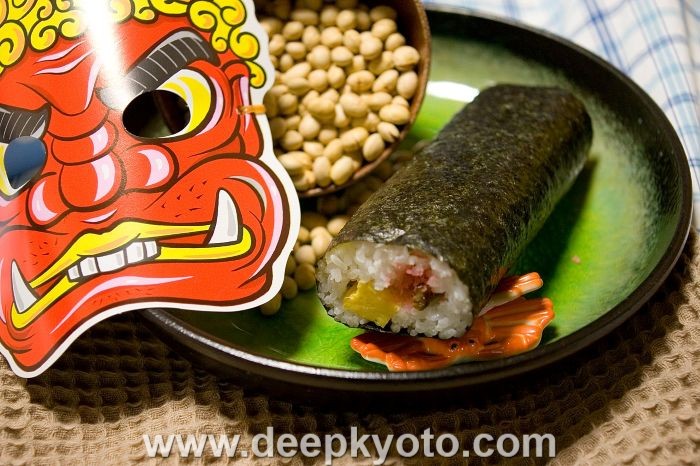
Devils & Beans
Held every year in early February, and this year on February 3rd, Setsubun (節分 or “division of the seasons”) is held to mark the official end of winter and the beginning of spring and it is connected to the traditional New Year celebrations of the old lunar calendar. With the division of the seasons comes the opportunity to make a fresh start, so a special ritual is held on this day to drive away any lingering evil spirits from the previous season that may be harboring bad luck or disease.
This ritual is called mamemaki (豆撒きor “bean scattering”) and in most households it consists of throwing roasted soybeans either at the entrance to the home or at someone (usually the oldest male member of the household) who has obligingly taken on the role of unseen dark forces by wearing a devil-mask. While throwing the beans, participants will shout “oni wa soto!” (鬼は外! or “devils out!”) and “fuku wa uchi!” (福は内! or “good luck in!”). These soybeans are called fukumame (福豆 or “lucky beans”) and are traditionally believed to purify the house of evil influences.
Perhaps these days though, the ritual is done less out of traditional belief than in the simple joy of raining beans down on some poor guy wearing a mask. The question may occur to you: why would evil spirits be so terrified of innocent little beans? One suggested answer to this mystery lies in the pronunciation of the Japanese word for bean (豆) which is “mame”. Another word which is pronounced “mame” is 魔滅, which has the rather dramatic meaning of “devil destruction!”
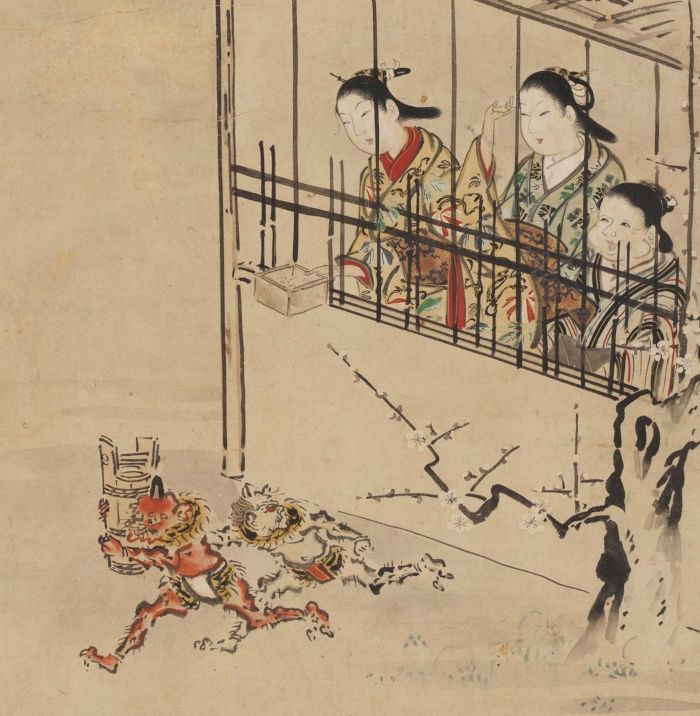
Lucky Food
Scattering beans will purify the house, but for the full ritualistic remedy and continued good health throughout the year, you need to eat them too. Traditionally you are supposed to eat the same number of beans as the age you will become that year, so as the years go by and the older you get, the more beans you have to eat. Soy beans are of course highly nutritious, so maybe this is no bad thing, but in my own case this year it means I will be quite literally full of beans.
Another culinary traditional is the eating of a special sushi roll called ehō-maki (恵方巻 or “blessed direction roll”) on the evening of Setsubun while making a wish. The ehō-maki is a long sushi roll containing 7 different ingredients, because that is considered a lucky number, and typically these include egg, cucumber, eel, and shiitake mushrooms. Eating ehō-maki is highly ritualized and has three separate elements that you should follow if you want your wish to come true:
1. You have to eat the whole thing in one go.
2. You have to eat it in complete silence.
3. You have to eat it while facing in a lucky direction.
The lucky direction is decided according to the rules of traditional Chinese astrology, and this year (2026) this is south-southeast. This custom began in western Japan but has now spread throughout the country and on Setsubun you can find ehō-maki on sale in every supermarket and convenience store.
Public Events
Bean scattering doesn’t just take place in private homes, but in public places too. Many shrines and temples hold special events which include bean-scattering into the crowd and sometimes fully costumed devils roaming the grounds and scaring all the kids. At the bigger shrines and temples, such as Zozoji Temple or Sensoji Temple in Tokyo, celebrities will be invited to throw the beans from a stage, and people will try to catch them for good luck. In Kyoto’s Yasaka Jinja Shrine it is maiko (apprentice geisha) who throw the beans cheerfully into the crowd.
Public events such as these can be a lot of fun, but if you want to celebrate Setsubun in your own home, you can buy complete bean-throwing kits in most Japanese convenience stores which include both masks and beans. Where will you celebrate Setsubun this year?
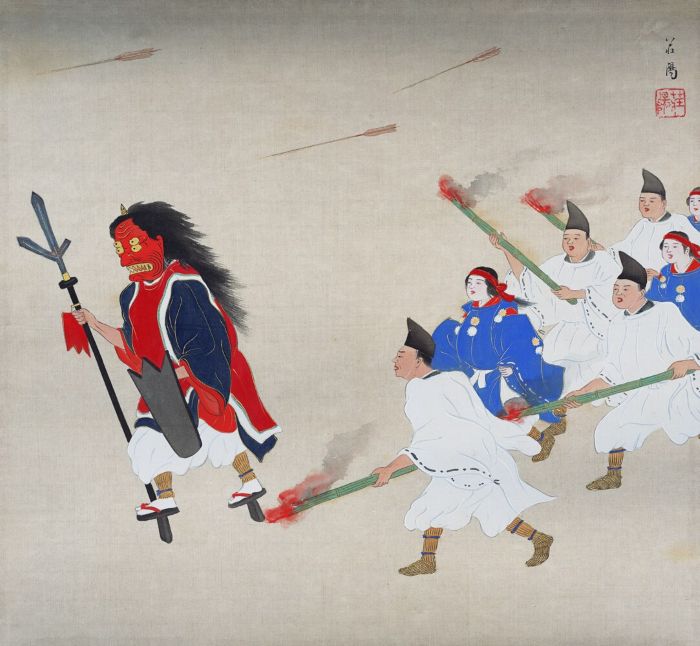
Setsubun in Kyoto
Not too surprisingly Kyoto has a wealth of diverse events celebrating Setsubun at many different shrines and temples and just a small selection are shown below. And although Setsubun is officially celebrated on February 3rd this year, some venues, like Yoshida Shrine, Shogoin Temple, Yasaka Shrine, and Mibu-dera Temple will hold their events and celebrations over two days – from February 2nd to 3rd. Note also that Iwashimizu Hachimangu Shrine in Yawata also holds its event on the weekend before Setsubun. Click the links provided for further details.
Tsuina (追儺) events to drive off demons will be held at the following locations:
Yoshida Shrine – February 2 (the time is undisclosed to discourage overcrowding)
Shogoin Temple – February 3 at 13.00
Kurama-dera Temple – February 3 at 14.00
Rozanji Temple – February 3 at 15.00
Iwashimizu Hachimangu Shrine – February 1 at 15.00
Bean-throwing events with Maiko dancers can be seen at the following locations:
Yasaka Shrine – February 2nd and 3rd, 13.00 and 15.00 (both days)
Senbon Shakado Temple – February 3 at 15.00
Kitano Tenmangu Shrine – February 3 at 13.00
Setsubun is also a wonderful opportunity to catch a performance of Kyogen (狂言), a traditional type of comic play. You can see Kyogen performances at the following locations:
Mibu-dera Temple – February 2nd and 3rd, 17.00 – 20.00 both days
Heian Jingu Shrine – February 3rd at 12.00
Senbon Shakado Temple – February 3rd at 15.00
Kitano Tenmangu Temple – February 3rd at 13.00
Full text by Michael Lambe. All rights reserved.
Image 1: Sakura Chihaya, CC BY-SA 2.0; Image 2: Detail from Shimabara Courtesans Exorcizing Demons by Miyagawa Issho, Public Domain; Image 3: Tsuina at Yoshida Shrine, Kyoto by Nakajima Soyo, Public Domain.
See also:
Maiko at Yasaka Jinja



Leave a Reply